


Call Center
02-518-0680
Call Center
02-518-0680Earthing matters for electrical and electronic systems. The purpose of earthing and bonding is safety and electromagnetic compatibility (EMC). Earthing products and earth conductors come in a range of materials. As well as choosing standard-compliant earthing products, they have to suit the soil conditions, for the sake of both performance and service life. We also design, install and maintain these systems, and measure earth resistance and soil resistivity to inform the design.
What makes a good grounding system
• The earth conductor must have good electrical continuity and low earth resistance to standard
• Standard-compliant ground rods, for good conductivity and corrosion resistance
• Buried conductors should use permanent connections made by exothermic welding, welding or compression. Where clamping is used, extra corrosion protection measures should be added
• The earth conductor must be large enough to carry safely any short-circuit current that could arise in the system
• Impedance must be low enough to limit the voltage measured against earth and to let overcurrent protection devices in the circuit operate effectively
• There must be measures against the corrosion caused by joining dissimilar materials
LPI earthing products can be applied in designs following EIT, IEC, BS EN, NEC and IEEE standards, with properties conforming to IEC 62561 and UL 467, and with test results and certificates provided.
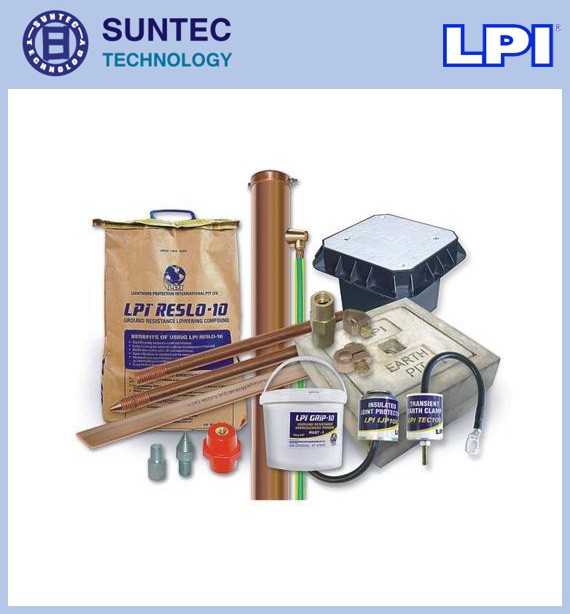
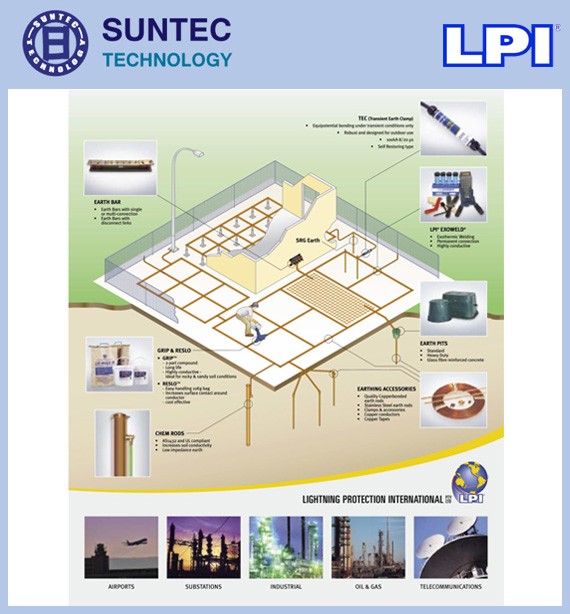
LPI earthing products are as follows:
1. Earth or ground rods, such as copperbonded earth rods, solid copper earth rods and solid stainless steel earth rods
2. Connectors, such as mechanical clamps, bond and clamp, and earth points
3. Earth plates and earth mesh, such as solid copper earth plate and lattice copper earth plate
4. Earth conductors, such as solid copper tape, tinned solid copper tape, stranded copper conductor and braided copper conductor
5. Exothermic welding products (LPI EXOWELD)
6. Earth busbars, such as electrical earth busbars and communication earth busbars
7. Isolating spark gap devices, such as insulated joint protectors and transient earth clamps
8. Earth inspection pits
9. Earthing enhancing compounds
10. Chemical earth or ground rods
We have long designed and installed nurse call systems, fire alarm systems
and lightning protection systems for both private companies and government agencies.
Earthing and bonding have two main purposes: safety, and electromagnetic compatibility (EMC) for electrical and electronic systems.
The earth conductor must have good electrical continuity and low earth resistance to standard. Use standard-compliant ground rods for good conductivity and corrosion resistance. Buried conductors should use permanent connections made by exothermic welding, welding or compression. If clamping is used, extra corrosion protection measures should be added.
Yes. As well as designing, installing and maintaining systems, we measure earth resistance and soil resistivity so that the system can be designed to suit the actual ground conditions on site.
Soil conditions differ from site to site and have a direct effect on how well current is carried to earth and on how long the equipment lasts. Choosing the right materials matters just as much as choosing standard-compliant equipment.
