


Call Center
02-518-0680
Call Center
02-518-0680When lightning strikes a building structure or a conductor, or lands close to one, the resulting current and voltage are induced into power or signal conductors. That produces overvoltage in the electrical and electronic systems and damages the equipment connected to them. Overvoltage generated by the electrical system itself, such as short circuits and switching operations, can damage that equipment just as easily. To prevent this, a surge protection scheme has to be designed and surge protective devices (SPD) selected in line with international standards.
The standard divides surge protective devices into three classes:
SPD Class I handles lightning current with 10/350 µs and 8/20 µs waveforms
SPD Class II handles lightning current with the 8/20 µs waveform
SPD Class III handles lightning current and voltage with 8/20 µs and 1.2/50 µs waveforms
Surge protective devices fall into two types:
1. Power Line Surge Protective Devices
2. Data Line Surge Protective Devices
LPI surge protective devices can be applied under EIT, IEC and IEEE standards, and are tested to IEC 61643 and UL 1449, with test results and certificates provided.
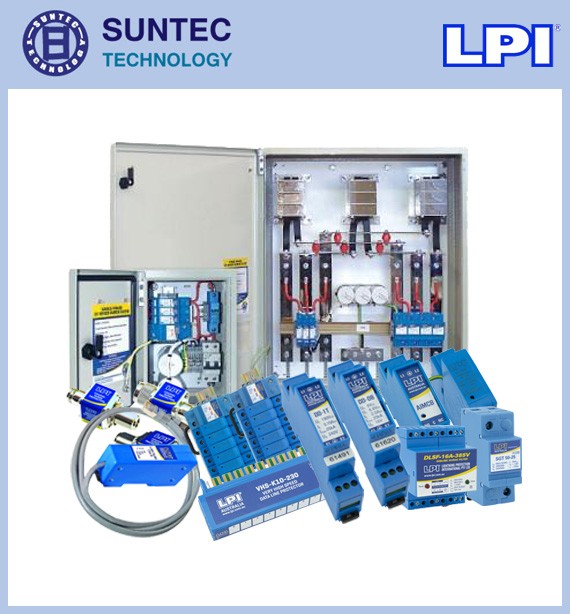
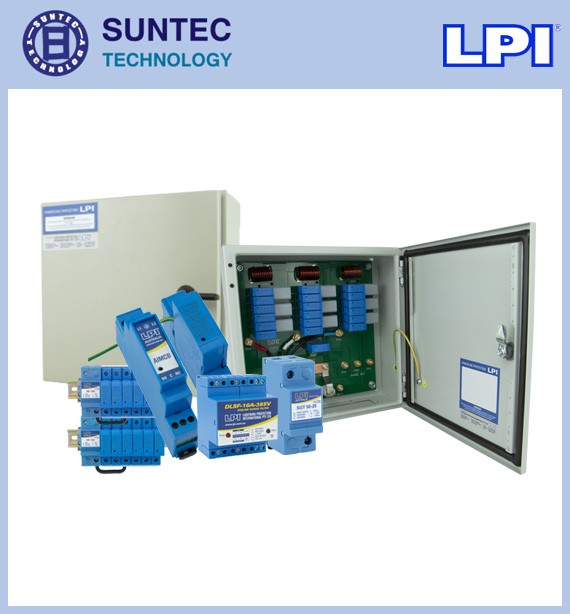
A device that reduces the voltage level of high-energy electrical systems, protecting against large external surges such as lightning strikes and electrical switching operations. There are two connection arrangements:
1) Parallel (shunt protection)
• Class I and Class II surge protective devices applied at the main distribution board (MDB) and at sub-distribution boards (DB or LP)
2) Series (series protection)
• Class III surge protective devices and surge filters applied to protect highly sensitive equipment
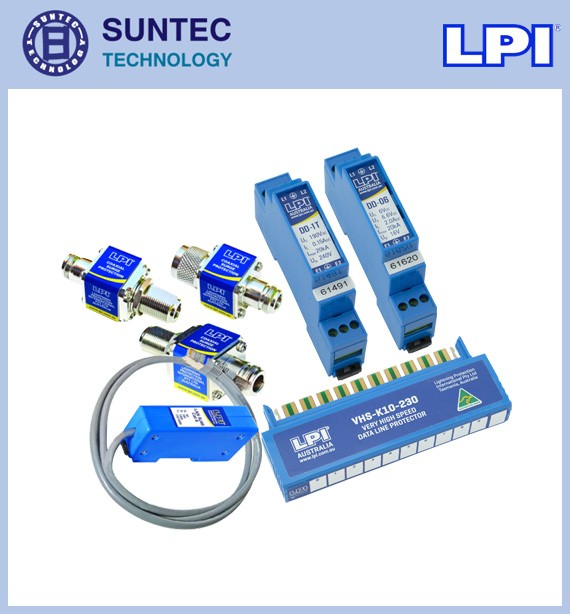
Used to protect signal lines from damage and keep them as safe as possible, covering telephone lines, PABX, CCTV, VHF and UHF transmission lines, computer signal cables and LAN cables.
We have long designed and installed nurse call systems, fire alarm systems
and lightning protection systems for both private companies and government agencies.
The standard defines three classes. SPD Class I handles lightning current with 10/350 µs and 8/20 µs waveforms, SPD Class II handles the 8/20 µs waveform, and SPD Class III handles lightning current and voltage with 8/20 µs and 1.2/50 µs waveforms.
It protects against overvoltage induced into conductors when lightning strikes the building structure or lands nearby, and also against overvoltage generated by the electrical system itself, such as short circuits and switching operations.
Two groups: power line surge protective devices and data line surge protective devices. Details are in the list at the bottom of this page.
Yes, it is still needed. A lightning conductor system protects the building structure, but lightning current and voltage can still be induced into power and signal conductors. Surge protective devices add a further layer that looks after the electrical and electronic equipment inside the building.
