


Call Center
02-518-0680
Call Center
02-518-0680The lightning protection system (LPS) plays a vital part in reducing the damage a lightning strike can do to a building structure, and to the lives and property inside it and around it. If the protection system is not installed to standard, or is not inspected and maintained regularly, the building can still be at risk of lightning damage.
There are two standard-backed lightning protection systems:
1. The Faraday Cage system, backed by EIT, IEC 62305 and NFPA 780
2. The Early Streamer Emission (ESE) system, backed by NFC17-102
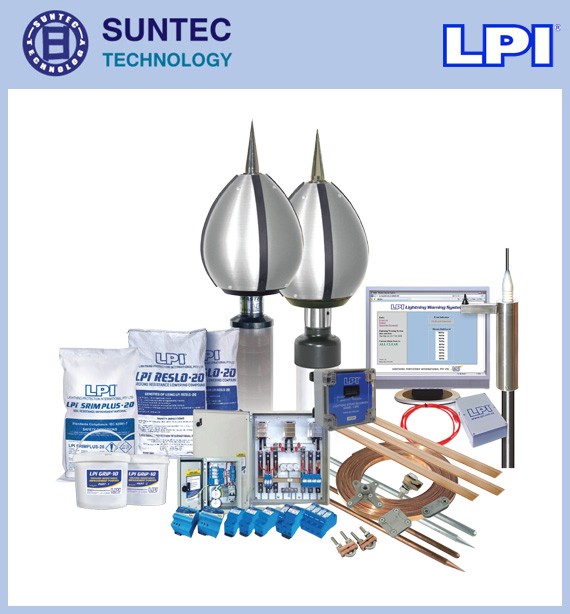
LPI air terminals, in both Early Streamer Emission (ESE) and conventional forms, meet standards such as NFC17-102, IEC 62305, IEC 62561 and AS/NZS 1768. They are tested in a high voltage laboratory and come with certificates and test reports for the relevant standards. After the lightning conductors are installed, the equipment can be checked with the LPI ESE Stormaster Tester and Lightning Counter Tester.
For our customers' peace of mind, we are glad to provide insurance cover of 10-50 million baht on every project where we install a lightning protection system.
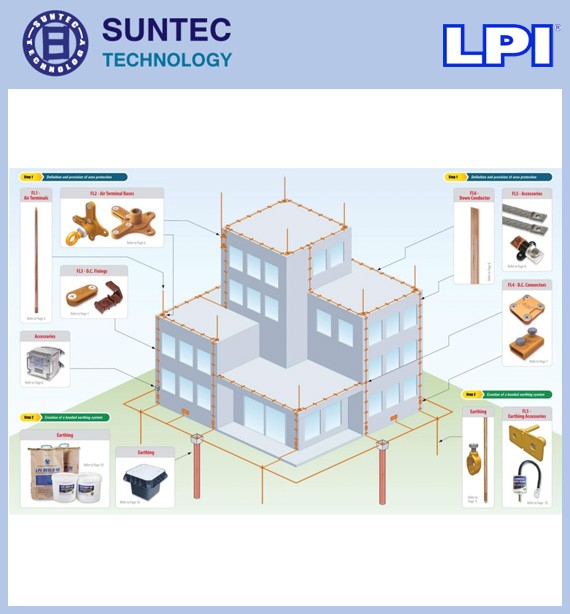
The Faraday Cage lightning protection system can be designed to EIT 2009-59, IEC 62305-3, NFPA 780 and ITU K.112. These standards offer several approaches to designing and installing a Faraday Cage system. Modern lightning protection equipment comes in many forms and materials. As well as choosing standard-compliant equipment, it has to suit the environment the system will be installed in. We provide a complete service: designing and installing Faraday Cage systems, maintaining them, and inspecting lightning protection systems with specialist tools certified to international standards.
A lightning protection system consists of:
1. Air termination system
Air terminal positions can be designed by the protective angle method, the rolling sphere method or the mesh method
2. Down conductor system
Down conductors should be evenly spaced, between 10 and 20 metres apart
Down conductor forms: solid round, solid tape and stranded
3. Earth termination system
Earth termination arrangements include radial and vertical electrodes, and ring or foundation earthing
LPI lightning protection equipment can be applied in designs following EIT 2009-59, IEC 62305-3, NFPA 780 and ITU K.112, with properties conforming to IEC 62561.
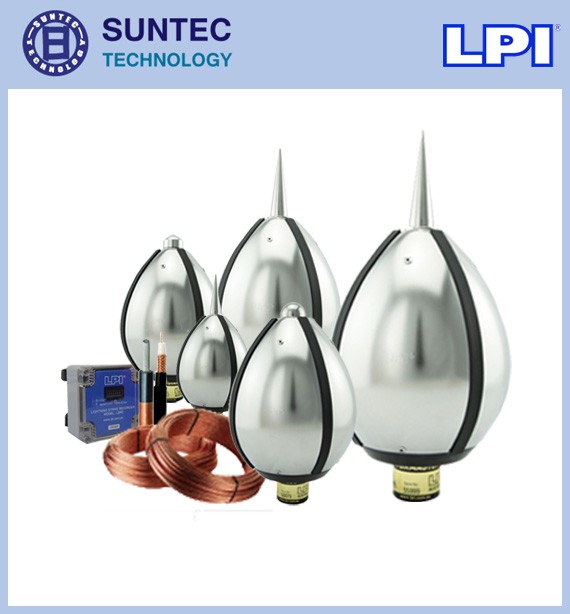
The Early Streamer Emission (ESE) lightning protection system uses air terminal technology that generates more streamer current than other types and works on a low impedance principle, giving a considerably wider protection radius. One air terminal mast therefore protects a wide radius, which also reduces the cost of the installation. To be effective, an ESE system must apply the protection measures of NF C 17-102 and use conductor materials meeting EN 50164-2 throughout.
LPI ESE lightning conductors protect effectively against lightning by covering four essentials:
1. Intercepting the lightning charge at the designed point
2. Carrying the lightning charge safely to earth
3. An earthing system that disperses the charge quickly
4. Preventing induced lightning current from harming people, objects or nearby electrical equipment
LPI Early Streamer Emission (ESE) air terminals are tested in a high voltage laboratory, with certificates and test reports to NF C 17-102, and properties conforming to IEC 62561-2. For our customers' peace of mind, we are glad to provide insurance cover of 10-50 million baht on every project where we install a lightning protection system.
We have long designed and installed nurse call systems, fire alarm systems
and lightning protection systems for both private companies and government agencies.
Two: the Faraday Cage system, backed by EIT, IEC 62305 and NFPA 780, and the Early Streamer Emission (ESE) system, backed by NFC17-102.
LPI air terminals, in both Early Streamer Emission (ESE) and conventional forms, meet standards such as NFC17-102, IEC 62305, IEC 62561 and AS/NZS 1768. They are tested in a high voltage laboratory and come with certificates and test reports for the relevant standards.
Yes, it does. If the installation does not follow the standard, or if it is not inspected and maintained regularly, the building can still be at risk of lightning damage.
It depends on the structure of the building, the area you need to protect and the standard your project has to follow. Details of each are in the list at the bottom of this page, or our engineers can survey the site and advise before you decide.
